


THE JOURNEY
Three seasons. One question: How do we grow through life?
Season One · The Beginning
Chapter One
Every Revolution Starts With One Idea
A story about Imani, motherhood, innovation, and a question I never thought I would have to ask.
A Revolution That Changed the Way Mothers Pump Didn't Happen Overnight
If you asked me today, “Does the world still need Imani?”, I would have to be honest: this is a question I have been asking myself more and more over the past few years.
There are so many breast pumps in the market now. Prices keep getting lower. More and more companies are making Handsfree Breast Pumps, and some products look increasingly similar.
Sometimes I wonder, what makes Imani different now?
Whenever I think about that question, though, I find myself going back to the beginning: why Imani existed in the first place.
2018: When Handsfree Breast Pumping Was Still New
In 2018, Imani made a choice that may not have seemed necessary to everyone at the time. Instead of simply making another traditional breast pump, they wanted to create something that would give mothers more freedom while breastfeeding.
Today, the idea of a Handsfree Breast Pump feels almost ordinary. But it wasn't always this way.
There were already advanced wearable breast pumps in the market, including brands such as Elvie and Willow. They were beautifully designed and introduced an exciting new possibility: a mother could pump without having to sit beside a traditional breast pump the whole time.
But they were also expensive.
Many mothers liked the idea. They wanted one. But for many families, it was still difficult to justify spending that much money on a breast pump.
It was almost like looking at something and thinking, “I would love to have that, but perhaps it's not for me.”
So most mothers continued using traditional breast pumps. They sat down several times a day, sometimes even eight times, and put whatever they were doing on hold while they pumped.
For a mother who had just given birth and was already exhausted from feeding, caring for a baby, recovering physically and trying to keep up with everyday life, sometimes what made her stop breastfeeding wasn't that she didn't love her baby.
It wasn't that she wasn't trying hard enough.
She was simply tired.
And sometimes, being tired is enough to make something that was already difficult feel impossible.
What Did Imani See?
This was the problem Imani saw.
They weren't simply asking, “How can we make another breast pump?”
They were looking at something much more practical:
Could we make Handsfree Breast Pumping easier and more affordable for more mothers?
It sounds simple when we say it today. But making it happen was anything but simple.
The Imani engineering team had more than 15 years of experience in breast pump development. For the first Imani i2, they spent seven years researching, testing and refining the product.
Seven years is a long time to work on one idea.
When we see a finished product, it is easy to forget everything that happened before it reached our hands. We don't see the designs that were changed, the tests that had to be repeated, or the moments when something still wasn't good enough.
The team knew that a breast pump wasn't something a mother would use once in a while. A mother might use it four, five or even more times a day.
So it couldn't simply be a machine that worked.
It needed to be comfortable. Light. Reliable. Easy to clean. Silent. And practical enough that a mother would actually want to use it every day.
When something becomes part of your daily life, the small details stop being small.
When “I Want One” Became “I Can Have One”
In 2018, the first Imani i2 was launched.
It was lighter, simpler and designed to make Handsfree Breast Pumping accessible to more ordinary families.
And I think this is one of the most important parts of the story.
Technology only becomes truly meaningful when it becomes accessible.
Something that once felt out of reach could now feel like:
“Maybe I can have this too.”
Within a few years, Imani entered more than 25 countries. More mothers around the world began using Handsfree Breast Pumps, and the idea gradually became part of everyday life.
Today, we see mothers pumping while working, looking after their children, doing things around the house, travelling or simply getting on with their day.
It feels normal now.
But sometimes, the things that change our lives become so normal that we forget they were once new.
Then the Market Changed
Success brings competition.
More brands entered the market. More OEM products appeared. There were more designs, more choices and, eventually, lower prices.
From a consumer's point of view, this is not necessarily a bad thing.
More mothers can afford a Handsfree Breast Pump. More mothers can try one. More mothers may discover that pumping does not have to completely interrupt their day.
In a way, that is also what Imani wanted from the beginning: for Handsfree Breast Pumping to become something more mothers could access.
But when an innovation becomes widely available, another question begins to emerge.
Today, you can open an online marketplace and find countless Handsfree Breast Pumps. Some look very similar. Some have similar features. Some are available at prices that are surprisingly low.
And of course, consumers look at price.
Why wouldn't they?
Everyone wants good value for their money.
But after working with maternal and baby products for so many years, I sometimes find myself asking a different question:
What are we really paying for when we buy a breast pump?
Is it the plastic? The motor? The logo?
Probably not.
Some of the most expensive parts of making a product are the things consumers never see.
Research. Testing. Materials. Quality control. Safety requirements. Certifications. And years of engineering experience.
None of these things look particularly exciting in a product photo. You cannot always see them.
But they are there.
Why I Still Respect Korean Manufacturing
This is one of the reasons I have always had a deep respect for Korean manufacturing.
Korea has strict requirements for many maternal and baby products. Meeting these requirements takes time and money. Sometimes, it also means that product development takes longer.
From a business point of view, it can be frustrating to see products entering the market faster and at much lower prices.
But from a mother's point of view, I also believe that some things should not be judged by price alone.
A maternal product is not just another consumer product.
It is used by a mother, and by the little baby in her arms.
That is why I believe there are certain costs that should not simply be treated as costs that need to be cut.
Why I Brought Imani to Malaysia
In 2019, I discovered Imani.
What caught my attention wasn't simply the number of features or how the product looked.
It was a very simple thought:
Maybe breastfeeding could be a little easier.
I am a mother too. I know what pumping feels like. I also know that when a mother is already exhausted, even a small amount of extra effort can feel like too much.
One less step.
A little less cleaning.
A little less restriction.
A little less time being tied to a machine.
Sometimes, that small difference is enough for a mother to think:
“Okay. Maybe I can keep going.”
That was what I believed in when I brought Imani to Malaysia in 2019.
My hope was simple.
If pumping could become easier, perhaps a mother could continue breastfeeding for another three months. Maybe six months. Maybe a year.
Maybe she could reach a breastfeeding goal that she once thought was beyond her.
The Mothers I Have Met Along the Way
Over the years, I have met many mothers with stories like this.
Some were able to continue breastfeeding a little longer because pumping became easier. Some told me that without a more convenient way to pump, they probably would have stopped much earlier.
Every time I hear a story like that, I remember why I brought Imani to Malaysia in the first place.
Because what I saw back then was never just a machine.
I saw a little more freedom for a mother.
A little more time.
A little less stress.
And perhaps, one more reason to keep going.
That has always meant more to me than simply selling another product.
Nine Years Later, I Have a Question
But nine years later, the market looks very different.
There are more products. Lower prices. More competition. Consumers are more informed and more willing to compare.
And one question comes up more often:
“Why should I pay more for a brand?”
It is a fair question.
In fact, I believe consumers should ask it.
But it has also forced me to face a question I never really thought I would have to ask:
If everyone can make a Handsfree Breast Pump, what is left for Imani?
What Is the Value of Being First?
There is one thing I have come to understand more clearly over the years.
A brand should not be worth keeping simply because it is the cheapest.
And it does not need to be the only brand in the market.
Perhaps what matters is that, before many others saw the problem, someone saw it.
Someone believed there could be a better way.
And someone was willing to spend seven years, a great deal of time, money and effort trying to make that idea real.
Every great innovation is eventually copied.
That is simply how markets work.
And I don't hate that.
Competition has also made Handsfree Breast Pumps more affordable and accessible to more mothers today.
But when we look back, history is not only about who made something fastest, who sold it cheapest or who copied it best.
Sometimes, the story worth remembering is:
Who was willing to believe there could be another way?
And Now, I Am Asking Again
In 2018, Imani made that choice.
In 2019, I brought it to Malaysia.
And somehow, we made it all the way here.
Nine years. More than 25 countries. Countless mothers, countless pumping sessions, and countless ordinary moments that may have meant much more to a mother than anyone else could see.
And now, I find myself back at the question I started with:
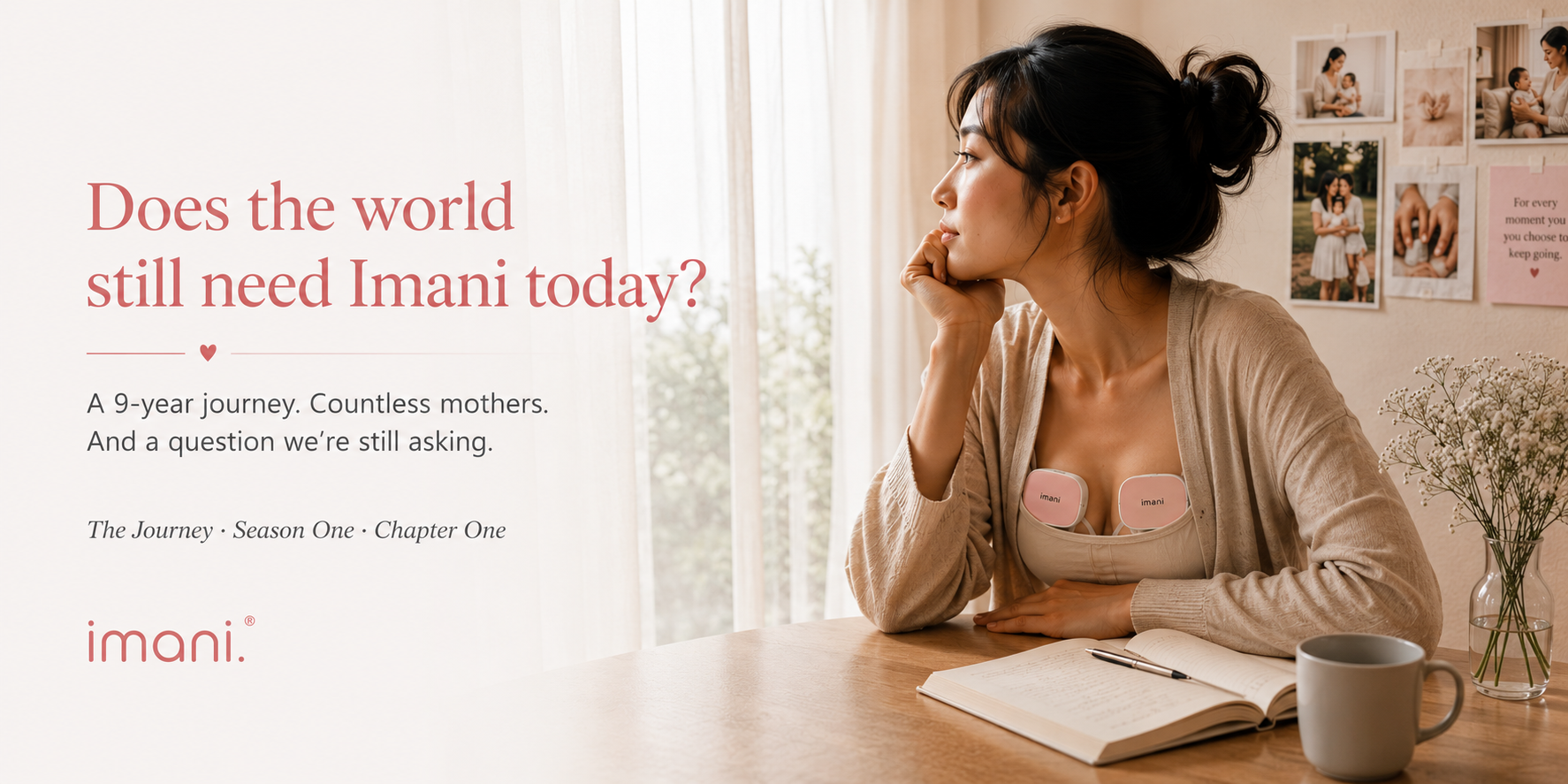
Does the world still need Imani today?
The Journey continues
Season One · Chapter 02
Seven Years Before One Product